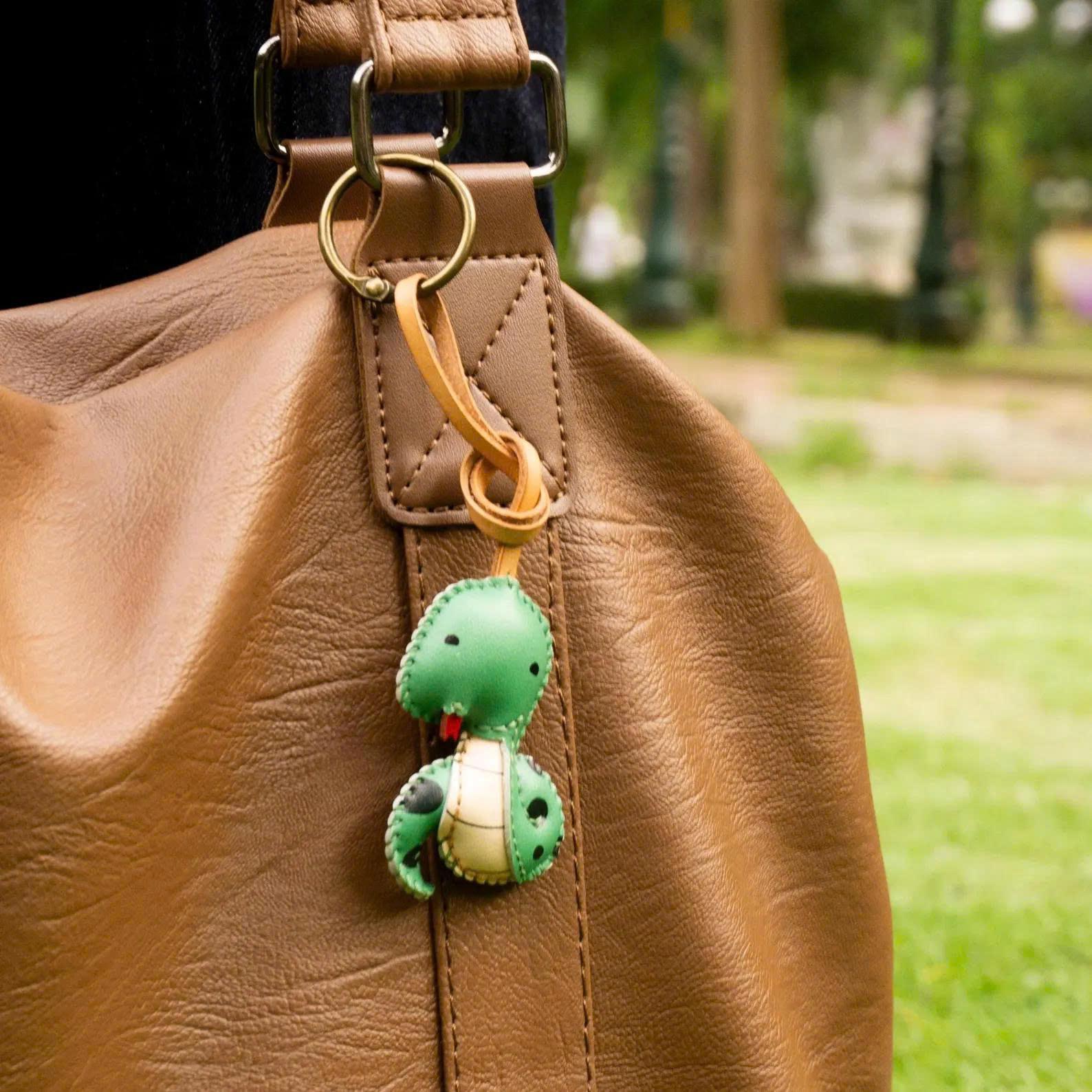
One Bag Charm, Minimalist Style
There is a particular kind of outfit that asks for almost nothing: a navy coat, straight-leg jeans, a plain tote, the same shoes that reliably get you out the door. On those mornings, adding another layer or a louder accessory can feel like changing the subject.
That is the useful premise of minimalist bag charm styling: not a ban on personality, but a decision to concentrate it. Instead of collecting several competing details on one handle, choose one small character, shape, or color that makes the bag feel intentional. The result is less about being noticed across a room and more about enjoying the object you pick up all day.
A single interruption in a quiet outfit
Minimal dressing often has a rhythm—repeated neutrals, clean lines, one familiar silhouette. A charm works best when it interrupts that rhythm once. Picture a black crossbody with a white shirt and charcoal trousers: a small warm-toned figure at the side of the bag changes the view when the bag is set on a café chair or carried through a lobby. It is a detail, not a second outfit.
Start by looking at the bag before looking at the charm. A structured work bag may invite a simple silhouette with one memorable color. A soft canvas shopper can take a more whimsical motif because the bag already feels casual. If you are browsing the full collection, resist the impulse to solve every mood at once. Save the pieces that make you pause, then choose the one that still feels right beside the bag you use most.
Give the charm one clear job
A single charm becomes easier to style when it has a role. Perhaps it is the cheerful note on an otherwise reserved office tote. Perhaps it helps you recognize your identical-looking gym bag in a row of lockers. Or perhaps it is simply the small thing that makes a long commute feel a little less uniform.
For example, a giraffe motif can bring a tall, graphic outline to a plain shoulder bag without requiring a patterned scarf or bright shoes to match. The giraffe bag charm is most compelling here as a lone accent: clip it where it can be seen, then leave the rest of the hardware and straps uncluttered. One idea reads more clearly than five.
Before committing, try the charm in three ordinary situations: bag on your shoulder, bag on a desk, and bag hanging from a chair. A placement that looks charming in a mirror can disappear behind the body or get lost against a busy coat. The right spot is usually the one that appears naturally as you reach for the bag.
Scale is a conversation, not a rule
Minimalism is not automatically tiny. It is about proportion. A compact bag often looks most settled with a charm that stays close to its edge rather than extending far below it. On a roomy tote, a small charm can look like a deliberate punctuation mark near the handle; a more visible shape can work too, as long as it is the only strong visual signal.
Use the bag’s seams and hardware as landmarks. On a satchel, try a side ring or top handle, where the charm joins an existing line. On a zip-top pouch, the zipper pull can make the charm feel integrated rather than added on. If you are still comparing options, the practical questions in How to Choose the Right Bag Charm Size offer a helpful next step. The goal is not mathematical precision; it is avoiding the sense that the charm is crowding the bag.
Edit the colors before you clip
One accent gives you a simple color decision. You can match a shade already in the outfit—a rust charm with a rust stripe in a scarf—or introduce a modest contrast, such as soft yellow against an olive bag. Either route looks calmer than trying to echo every color at once.
A useful test is to stand the bag beside your everyday outerwear. If a cobalt charm looks excellent against the tote but clashes with the coat you wear four days a week, it may become an occasional piece rather than your daily choice. Neutral bags are especially forgiving, but they do not need a fluorescent rescue. For more ideas on building contrast with restraint, see Colorful Keychains for Neutral Bags.
There is also nothing wrong with choosing a charm in a neighboring neutral—cream on tan, burgundy on brown, black on faded denim. The motif can carry the interest while the palette stays low-volume. If you like checking fresh combinations from time to time, new arrivals can be a useful place to look without abandoning the one-charm approach.
Let repetition turn it into a signature
The strongest minimal look is often made by repetition, not a daily reinvention. Leave the same charm on your weekday bag for a few weeks. You may notice that it becomes part of your routine: the visual cue before you leave home, the tiny familiar shape under a meeting table, the detail friends recognize when you arrive.
That consistency also clarifies whether the choice is genuinely yours. If you keep reaching for a playful animal even with a pared-back outfit, that is useful style information. If it starts to feel busy, take it off for a week rather than immediately replacing it with three more accessories. The edit is allowed to include empty space. For a broader take on choosing motifs that feel personal, read Accessory Gifts for Coworkers: Warm, Easy, and Appropriate.
The lightest finishing move
One bag charm will not transform every outfit, and it does not need to. Its appeal is smaller and more lasting: it gives an everyday carry a point of view while leaving room for the bag, the clothes, and the person carrying them. Choose a shape you want to see on an ordinary Tuesday, place it with purpose, and let the rest stay quiet.
That balance is why a single detail can feel more expressive than a pile of them. In a minimalist wardrobe, one well-chosen charm is not an exception to simplicity. It is the proof that simplicity can still have a sense of humor.